What this covers
Water arrives in a small number of ways and leaves in a smaller number still. The pages below are grouped by which of those a job actually addresses, because the wrong category is the usual reason a drainage job gets done twice.
Three questions sort almost every inquiry. Is the water on the surface or in the soil? Does it arrive from above the building or from below it? Is there anywhere lower to send it? Answer those and the right page is usually obvious — and so is the wrong one.
Foundation and below
Basement Waterproofing and Interior French Drain in Clinton, UT
An interior French drain breaks the slab edge along the basement wall, sets a perforated pipe beside the footing, and sends what it catches to a sump pump that lifts it outside.
Exterior French Drain and Waterproofing in Clinton, UT
An exterior French drain excavates to the bottom of the outside basement wall, coats the wall with a waterproof sealant, and lays a gravel-filled drain at the footing to carry water away before it touches the concrete.
Yard and landscape
Yard and Lawn Drainage in Clinton, UT
Water standing on a lawn either has nowhere lower to go, cannot soak into the ground it is sitting on, or is arriving faster than both.
Roof, drive and hard surfaces
Driveway and Garage Drainage in Clinton, UT
Water reaching a garage door is either sheet flow running down the paving, or roof water that was put on the paving by a downspout.
Urgent and repair
Emergency Drainage in Clinton, UT
Getting standing water away from a structure while it is still happening, then finding why it arrived. Those are two different jobs.
French Drain and Sump Pump Repair in Clinton, UT
A drain that has stopped is silted, root-bound, or crushed, and a pump that has stopped is a switch, an impeller, a valve, or a blocked discharge. Each has a different price.
Larger and paved sites
Commercial Drainage and Site Excavation in Clinton, UT
Drainage for a surface large enough to shed nearly everything that lands on it, where volume, grate loading and permitted discharge are all different questions than they are on a house.
Deciding between two
Interior vs Exterior French Drain in Clinton, UT
The same problem approached from two sides — a drain outside the footing, or one inside the slab feeding a sump. Access decides it more often than performance does. Outside is the more complete fix and the more disruptive one; inside is what remains when the outside cannot be dug.
French Drain vs Sump Pump in Clinton, UT
One moves water by gravity to somewhere lower; the other lifts it because there is nowhere lower to go. Fall decides it. Where a lot has fall, a drain needs no power and nothing to fail; where it has none, a pump is not the cheaper option but the only one.
When not to buy one
Water on the floor after a heavy rain, near one wall, with a downspout outside it. Fix the downspout first. Water that seeps through a wall in a wet spring and never in summer. Look at the grade first. A drain installed around either of those is money spent on the wrong cause.
Two checks worth making before anyone quotes you.
- Extend the downspouts. A roof outlet should discharge at least 6 feet from the wall, and 10 is better. One downspout can put hundreds of gallons against a footing in a single storm, and an extension costs a small fraction of a drain.
- Fix the slope. The ground in the first 10 feet should fall away from the house, about 6 inches over that distance. Where it falls toward the house instead, water is being delivered to the wall on purpose.
If either is wrong, correct it and watch one more storm before spending anything larger.
Read what a Clinton drainage job costs before calling anyone, and check the Clinton Utah French Drain service area to see whether your street is covered.
Back to Clinton Utah French Drain.
The ground under Clinton
Trusted across Clinton, Utah and Davis County
What this site is good for
-
Residential and commercial
A house with a wet basement and a site with standing water on a hardstanding are different jobs at different scales. Both are covered, and the pages say which is which.
-
Free, and nothing attached
Working out which job you actually have costs nothing and commits you to nothing. There is no fee to you at any point, because this site is paid by the contractor and not by you.
-
Your details are not for sale
An address sent here goes to a drainage contractor working in the area. It is never sold, and never passed to a second firm.
-
Permits named, not glossed
The pages name the authority that issues the permit for this work and the inspection that goes with it, so you can ask to see one before the first cut.
-
Every figure sourced and dated
Soil, rainfall and housing figures each name where they came from and when they were retrieved. Where a published estimate carries a margin of error, the margin is shown too.
-
One town, covered properly
This site is about one place and the towns within a short drive of it. It is not a national directory with a city name dropped into a template.
-
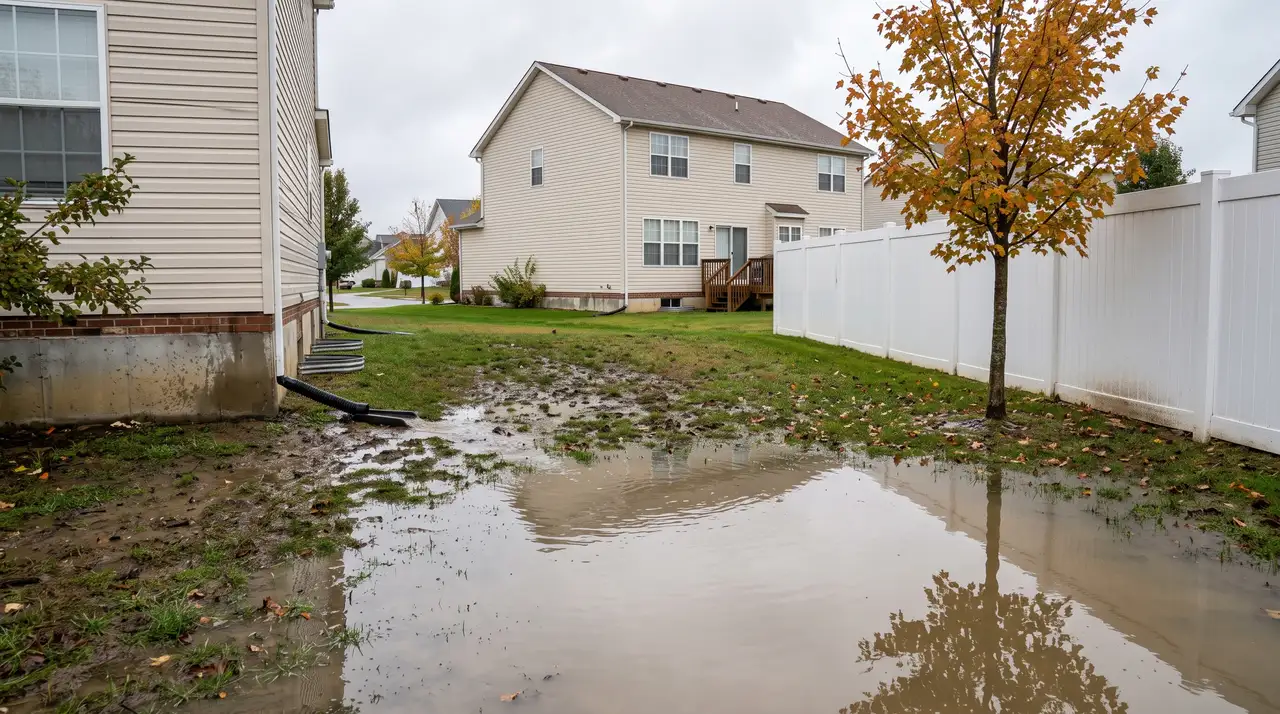
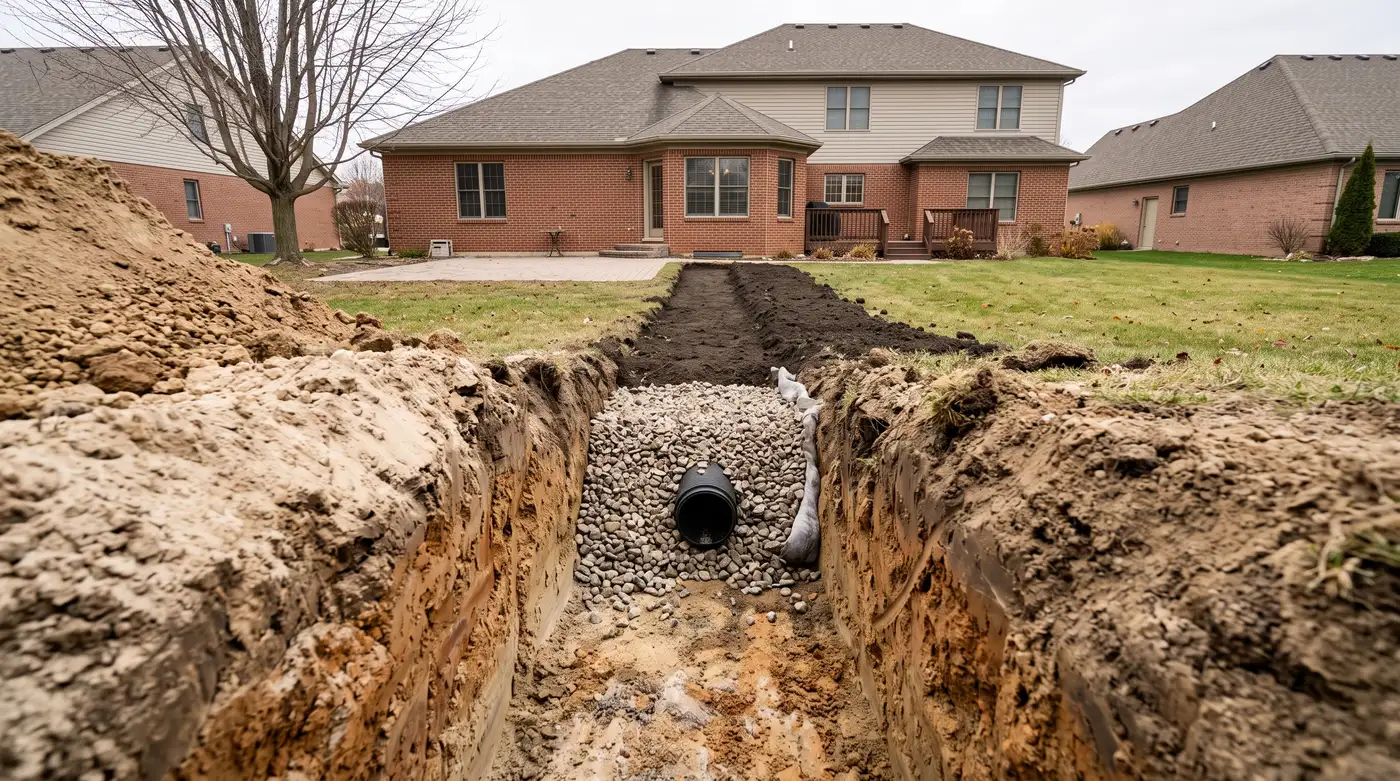
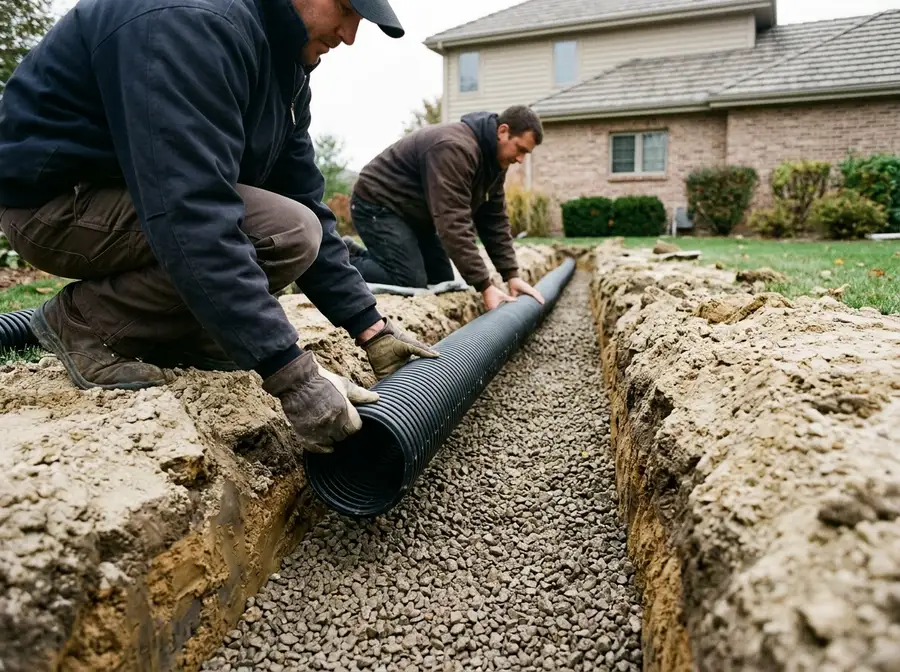
One run at four stages. The stone is the drain; the pipe is only how the water it collects gets out. -
Water standing at grade. Ground that sheds rather than takes is what puts it there. -
Pipe seated on the stone bed. Trench walls cut clean, so no soil falls back into the stone.

Ground that is saturated has nowhere to put the next storm, and water sitting against a wall keeps working on it.
What happens after you send an address
-
The address first, and only then who you are
The first screen asks for the property address and checks that a contractor covers it. Only if one does does it ask for a name, a phone number and an email — there is no point taking your details to tell you nobody serves your street.
-
Your details are not for sale
It goes to a drainage contractor working in Clinton. The details are never sold, and never passed to a second firm.
-
No cost, and nothing attached
There is no fee for sending an address and no obligation that follows from it. Deciding the work is the wrong work is a perfectly good outcome.
-
Who does the work
An independent drainage contractor, not the publisher of this site. Who runs this site, and where every figure on it comes from, is set out on the about page.